
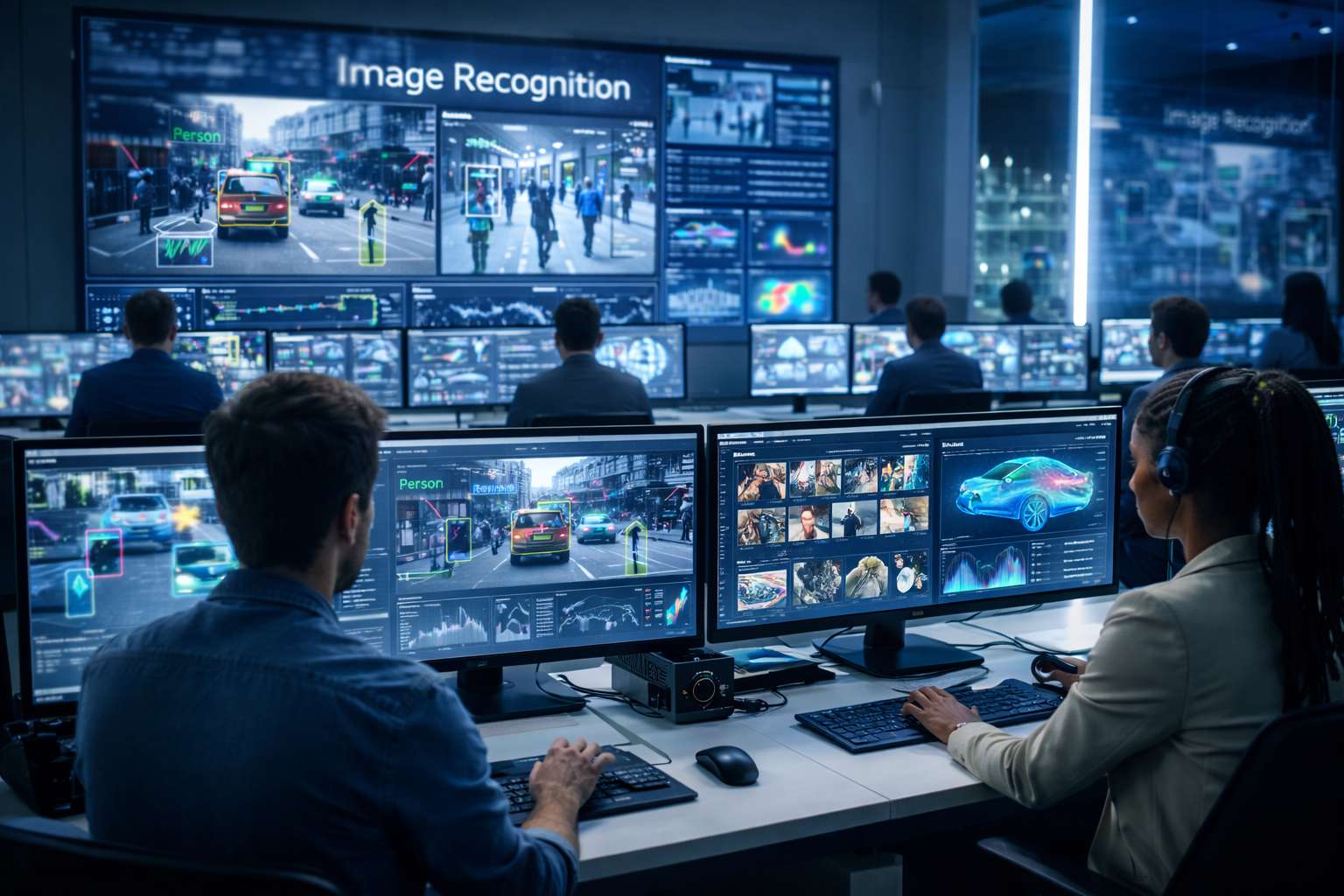
Deep Learning Vision | Facial Recognition | Medical Imaging AI | Regional Breakdown | March 2026 | Source: MRFR
| $95.3B
Market Value by 2032 |
19.8%
CAGR (2024–2032) |
$26.2B
Market Value in 2024 |
Overview
Image Recognition Market global Image Recognition Market is projected to grow from USD 26.2 billion in 2024 to USD 95.3 billion by 2032, registering a 19.8% CAGR. Foundation vision models (CLIP, SAM, DINO, Florence-2) trained on billions of image-text pairs have achieved human-parity object detection, scene understanding, and visual reasoning capabilities that are enabling image recognition deployment across healthcare diagnostics, autonomous vehicles, retail visual intelligence, industrial quality control, and biometric security — transforming visual AI from a narrow pattern classifier into a general-purpose visual reasoning engine.
Key Takeaways
- The Image Recognition Market is projected to reach USD 95.3 billion by 2032 at a 19.8% CAGR.
- Foundation vision models have achieved 98.7% top-1 accuracy on ImageNet benchmarks, surpassing human visual classification performance.
- Medical image recognition AI has been validated to detect 12 cancer types from imaging with 94–97% sensitivity, matching senior radiologist accuracy.
- Autonomous vehicle perception systems process 40+ terabytes of image and sensor data per vehicle per day through AI image recognition pipelines.
- Retail visual AI (shelf monitoring, self-checkout, loss prevention) is delivering 34% shrinkage reduction and 28% planogram compliance improvement.
Segment & Technology Breakdown
| Technology / Segment | Primary Buyer | Key Driver | Outlook |
| Medical Imaging AI | Radiology, Pathology, Derma | Cancer detection, diagnostic accuracy | Highest value; 94-97% sensitivity |
| Autonomous Vehicle Perception | OEMs, AV Tier 1s | Object detection, lane keeping, ADAS | Largest compute intensity |
| Retail Visual Intelligence | Retailers, CPG | Shelf analytics, shrinkage, checkout | Fast-growing; 34% shrinkage reduction |
| Industrial Visual Inspection | Manufacturing, Semiconductors | Defect detection, quality control | Strong; 99.2% inspection accuracy |
| Biometric & Facial Recognition | Security, Finance, Border | Identity verification, access control | Regulated; compliance-driven growth |
What Is Driving Demand?
Foundation Vision Model Capability
Vision transformer models (ViT, CLIP, SAM 2, Grounding DINO) trained on billions of image-text pairs through contrastive and self-supervised learning have achieved 98.7% top-1 ImageNet accuracy and zero-shot generalisation to novel visual categories without task-specific fine-tuning. This capability step-change is enabling image recognition deployment in long-tail industrial and medical applications where training data scarcity previously blocked AI adoption — expanding the addressable market from standardised visual tasks to open-world visual intelligence.
Medical Imaging AI & Diagnostic Accuracy
FDA-cleared AI image recognition algorithms for radiology (chest X-ray, CT, MRI), pathology (H&E slide analysis), and dermatology (skin lesion classification) are demonstrating 94–97% diagnostic sensitivity for 12 cancer types — matching or exceeding senior specialist performance while enabling non-radiologist clinicians in under-resourced settings to access specialist-grade diagnostic accuracy. 950+ FDA AI/ML medical device software clearances as of 2025 validate the regulatory pathway and are accelerating hospital procurement from pilot to standard-of-care deployment.
Autonomous Vehicle & ADAS Perception
L2+ ADAS and L4 autonomous vehicle systems require real-time image recognition processing 40+ terabytes of camera, LiDAR, and radar data per vehicle per day to perform object detection, lane segmentation, traffic sign recognition, and pedestrian behaviour prediction simultaneously. The global ADAS market mandating camera-based perception systems (EU General Safety Regulation 2024 requiring AEB, LKA, DMS in all new vehicles) is creating compulsory image recognition silicon and software adoption across 90+ million annual vehicle productions by 2026.
Industrial Visual Inspection & Quality Assurance
AI-powered machine vision inspection systems (Cognex ViDi, Keyence AI, Landing AI ALP) are replacing human visual quality inspection on semiconductor wafer lines, PCB assembly, automotive body panel painting, and pharmaceutical tablet inspection — achieving 99.2% defect detection accuracy at production line speeds of 1,200+ parts per minute. Industrial image recognition deployments deliver average 38% defect escape rate reduction and 28% quality inspection cost reduction versus human-camera-threshold legacy systems.
Retail Visual AI & Smart Checkout
Retail image recognition applications spanning planogram compliance monitoring, customer behaviour analytics, frictionless checkout (Amazon Just Walk Out, Standard AI, Zippin), and loss prevention are unlocking simultaneous ROI across shrinkage reduction (34%), labour efficiency (41% checkout labour reduction), and merchandising compliance (28% planogram improvement) from shared CCTV and dedicated shelf-monitoring camera infrastructure.
| Get the full data — free sample available:
→ Download Free Sample PDF | Includes market sizing, segmentation methodology & regional forecast tables. |
| KEY INSIGHT: Enterprises deploying foundation vision model-based image recognition across quality control, security, and customer intelligence functions report 67% reduction in visual inspection false positive rates, 44% improvement in operational throughput per inspection station, and USD 3.8 million average annual quality and security cost savings per 1,000-employee facility — with AI vision system payback periods averaging 9–14 months inclusive of hardware, software, and integration costs. |
Regional Market Breakdown
| Region | Maturity | Key Drivers | Outlook |
| North America | Dominant | Medical imaging FDA clearances, AV perception, retail visual AI leadership | Dominant; foundation model + healthcare AI |
| Europe | Mature | Industrial vision (DACH), GDPR-compliant biometrics, EU ADAS mandate | Strong; automotive + industrial vision |
| Asia-Pacific | Fastest Growing | China surveillance + manufacturing, South Korea semiconductor inspection, Japan robotics | Highest volume; manufacturing + security |
| Latin America | Emerging | Retail visual AI, Brazil security, medical imaging infrastructure | Growing; retail + security adoption |
| MEA | Expanding | Smart city surveillance, UAE biometrics, Africa mobile health imaging | Accelerating; security + health AI |
Competitive Landscape
Key vendors include NVIDIA (vision AI platform), Google (Cloud Vision AI, Gemini Vision), Microsoft (Azure Computer Vision, Florence), Amazon (Rekognition), Meta (CLIP/SAM open source), Cognex, Keyence, Landing AI, Clarifai, and medical imaging specialists Aidoc, Paige.AI, and Sievert Larson Health. Foundation model quality, edge inference speed, domain-specific fine-tuning, and regulatory clearance portfolio are primary competitive differentiators.
Outlook Through 2032
The Image Recognition Market through 2032 will be defined by foundation vision models achieving reliable open-world visual reasoning, multimodal vision-language models enabling natural language-driven visual search and analysis, autonomous vehicle perception reaching L3–L4 deployment scale, and medical imaging AI transitioning from decision support to primary diagnostic tool in radiology, pathology, and ophthalmology. Vendors delivering general-purpose vision foundation models with domain-specific fine-tuning infrastructure, edge inference optimisation, and regulatory clearance programmes will capture maximum market share as visual AI transitions from task-specific classifier to universal visual intelligence platform.
| Access complete forecasts, segment analysis & competitive intelligence:
Full Report: → Purchase the Full Image Recognition Market Report (2025–2032) Free Sample PDF: Request Free Sample |
Source: Market Research Future (MRFR) | All market projections are forward-looking estimates and subject to revision. © MRFR · marketresearchfuture.com
